House Advantage Single Deck Blackjack
The house edge is a statistical way of measuring the casino’s advantage over the player. Suggesting all games are played with six decks - which is a common size for a blackjack shoe - Spanish 21 has the best house edge for the player according to the blackjack house edge table on top of this page. Standard 21 Blackjack is good too since you can actually have the edge by playing perfect basic strategy with a single deck. Methodology: The 'optimal results' are based on perfect composition dependent strategy and the dealer shuffling after every hand, which benefits the player.The 'basic strategy with cut card' results are based on total dependent basic strategy, like the tables on this site, and the use of a cut card, which favors the dealer.
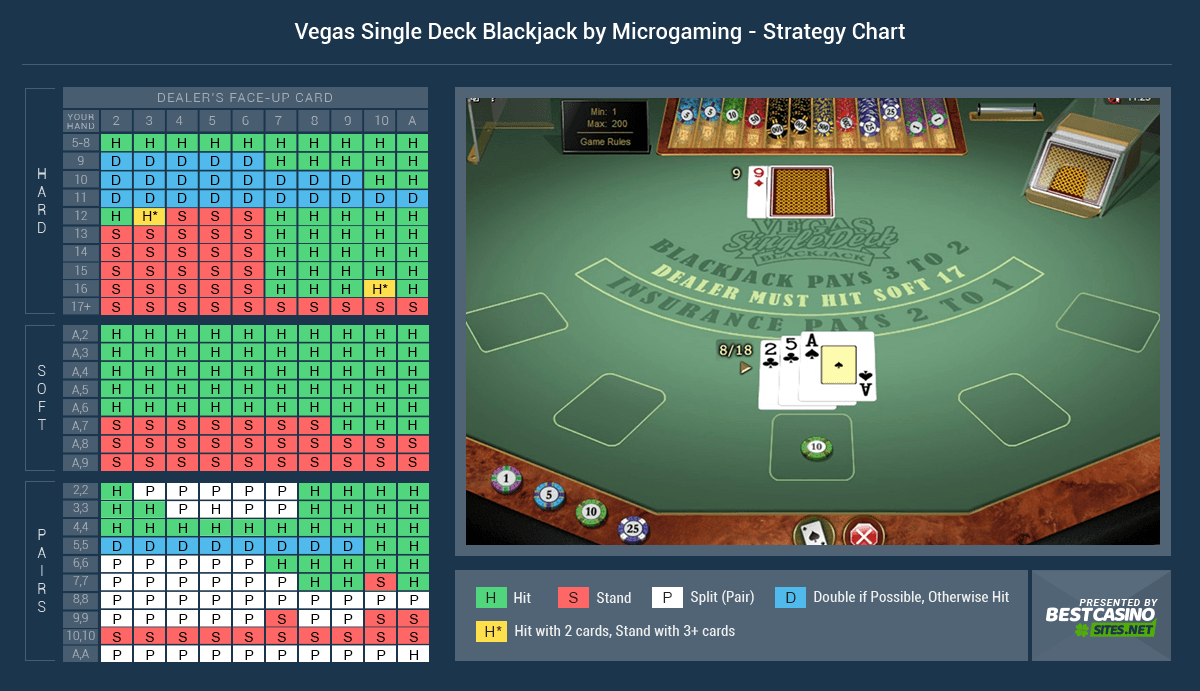
- Single Deck Blackjack Chart
- Single Deck Blackjack Strategy
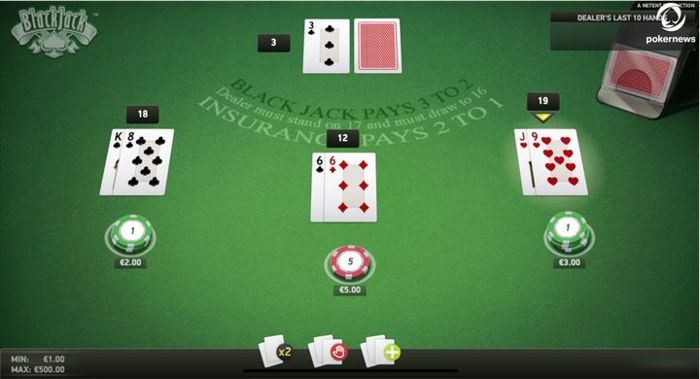
- Single Deck Blackjack Game
- House Advantage Single Deck Blackjack Rules
- Single Deck Blackjack Trainer
- Single Deck Blackjack Rules
- House Advantage Single Deck Blackjack Deck
Calculating the House Edge for Any Number of Decks and Blackjack Rules Set
By Arnold Snyder
(From Blackbelt in Blackjack, 3rd Edition, Cardoza Publishing 2005) © 2005 Arnold Snyder
Quick Link to Charts for Effects of Rules on House Edge
Card Counting is Not Enough
Many card counters believe that as long as a game is called “blackjack,” and is being offered by a legitimate casino, they can win by applying their counting systems. But the fact is that while some games can be beaten by card counting strategies many can’t, and table conditions make the difference.
This article will give you simple guidelines you can follow that will help to keep you from throwing your money away in unbeatable games.
First, let’s define table conditions. There are four distinct conditions of any blackjack game that directly affect the profit potential for card counters:
1. The number of decks in play. In U.S. casinos, this may currently range from one to eight.
2. Rules. There are about two dozen common rule variations, and dozens more uncommon variations, in U.S. casinos.
3. Crowd conditions. You may be the only player at the table, or one of as many as seven. Crowded tables mean fewer hands per hour and lower earnings for card counters.
4. Depth of deal, or deck penetration, between shuffles. Anywhere from 2% to 90% of the cards may be dealt out.
The House Edge and Depth of the Deal (Penetration)
Of all of these table conditions, penetration is by far the most important. When I published my first book, The Blackjack Formula, in 1980, many players were skeptical of the weight I gave to the effect of deck penetration. No other authors had mentioned penetration as an important factor up to that time, and I received numerous letters from players who simply could not believe that there was any great difference in profitability between a single-deck Reno game with 55% penetration and one with 65% penetration.
“10% is only five cards!” one player wrote to me. 'Yet your formula shows the advantage almost doubling with the same 1 to 4 spread. That’s impossible!” Other card counters, who were playing 4-deck downtown Vegas games with 70% penetration and 1 to 4 spreads, were incredulous of my claim that such a small spread, with such poor penetration, left them with barely a tenth of a percent advantage over the house.
These days, any decent book on card counting will tell you that penetration is the name of the game, but before my book in 1980 no one knew! None of the books on card counting had ever mentioned the importance of deck penetration before.
The general rule is this: The shallower the penetration, the larger the betting spread you must use to beat the game. With a bad set of rules and poor penetration, you may not be able to beat the game with any spread.
In most single deck games, you can’t win big unless more than 50% of the cards are dealt out between shuffles—with Reno rules (double 10/11 only and dealer hits soft 17), make that more than 60%. There are two main reasons for this: One, most single-deck games have poor rule sets; two, you generally can’t get away with a very big spread in single-deck games.
With 2-deck games, you’ll want at least 65% dealt out. (But don’t even bother with a 2-decker when playing Reno rules.) With 4 or more decks, a bare minimum of 70% of the cards should be dealt out. Regardless of the number of decks in play, a 10% difference in penetration will make a huge difference in your profit potential: A 6-deck game with 85% penetration (about 5 decks dealt) is vastly superior to a 6-deck game with only 75% (about 4 ½ decks dealt).
For more information on penetration, and a formula for quickly and easily calculating the profitability of any blackjack game, see the Snyder Profit Index in Chapter 11 of Blackbelt in Blackjack.
This rest of this article will deal with the number of decks in play and the effects of rules on the profitability of blackjack games. Before you can profit from any card counting system, you must overcome the house edge—that is, the cost in percent of playing the game. Below you will find all the information you need to quickly calculate the basic strategy house edge for any number of decks and any set of blackjack rules.
How the House Edge is Affected by the Number of Decks in Play
Now let's consider the effect of the number of decks shuffled together. All other conditions being equal, single-deck games would be the most profitable for card counters. The more decks being used, the less profitable the game becomes, not only for card counters, but for basic strategy players as well. A single-deck Vegas Strip game (blackjack pays 3:2, double down on any two cards, and dealer stands on soft 17), is pretty close to being a break even proposition for a basic strategy player. With four or more decks in play, and the same set of rules, the house has about a ½ percent edge. Use this chart to estimate your basic strategy (dis)advantage due to the number of decks in play:
| # Decks | Advantage |
| 1 | +0.02% |
| 2 | -0.31% |
| 3 | -0.43% |
| 4 | -0.48% |
| 5 | -0.52% |
| 6 | -0.54% |
| 7 | -0.55% |
| 8 | -0.57% |
How the Blackjack Rules Affect the House Edge
The second condition you must consider is the set of rules used on the game. Some rules, notably those that offer the player more options, are favorable to the player, assuming the player applies the correct strategy. Such rules would be surrender, doubling after splitting allowed, resplitting aces allowed, etc. Those rules that limit the player’s options, such as doubling down on 10-11 only, or no resplits, are disadvantageous to the player.
Some rules neither limit nor offer options to the player, but alter the dealer’s procedure. An example of one such rule would be “dealer hits soft seventeen.” This is disadvantageous to the player. An advantageous dealer rule, used occasionally in short-term special promotions, would be “blackjack pays 2-to-1.”
A different type of advantageous rules for the player are the “bonus” rules, such as “dealer pays $XXX bonus to player hand of 6, 7, 8 same suit.” Most bonuses, due to the rarity of the bonus hand(s) occurring, have very small $ value to the player.
Now let's look at the approximate effect of each rule on your basic strategy expectation. By adding the effect of the number of decks in play to the effects of the rule variations, you will know the house advantage against basic strategy players. Card counters call this the starting advantage, or the advantage off the top.
Most rules, to be sure, affect card counters differently than they affect basic strategy players. The house edge off the top, however, is always an important consideration, as this is what your skillful play must overcome.
For instance, insurance has no value to a basic strategy player, since correct basic strategy is to never take insurance. If a casino disallows insurance, however, this hurts card counters, since counters profit from their selective insurance bets. Likewise, the surrender option has little value to basic strategy players--less than one-tenth of 1 percent increase in expectation. For a card counter, however, surrender is, like insurance, very valuable.
In order to figure out our starting advantage, we need to begin by defining a benchmark game, i.e., a set of standard rules to which we can add or subtract the effects of the rule variations. Most authors define this benchmark game as Vegas Strip rules:
1. Dealer stands on soft 17.
2. You may double down on any 2 original cards.
3. You may not double down after splitting a pair.
4. You may split any pair.
5. You may resplit any pair except aces.
6. Split aces receive only one card each.
7. No surrender.
8. Dealer either receives a hole card, or the player’s original bet only is lost if the player doubles down or splits a pair and the dealer gets a blackjack.
9. Insurance is allowed up to one-half the player’s bet, and pays 2 to 1.
10. Player blackjack is paid 3 to 2.
Now the effect of any other rules must be accounted for in determining your starting advantage. These are the rule effects:
| Effects in Percent | |||
| Common Rules | 1-Deck | 2-Deck | Multi-Deck |
| Double on 10-11 only: | -0.26 | -0.21 | -0.18 |
| Double on 9-10-11 only: | -0.13 | -0.11 | -0.09 |
| Hits Soft 17: | -0.19 | -0.20 | -0.21 |
| No Resplits: | -0.02 | -0.03 | -0.04 |
| Double After Splits: | +0.14 | +0.14 | +0.14 |
| Resplit Aces: | +0.03 | +0.05 | +0.07 |
| Draw to Split Aces: | +0.14 | +0.14 | +0.14 |
| Late Surrender: | +0.02 | +0.05 | +0.08 |
| Late Surrender (H soft17): | +0.03 | +0.06 | +0.09 |
| Less Common Rules | |||
| Double on 8-9-10-11 only: | -0.13 | -0.11 | -0.09 |
| Double on 11 only: | -0.78 | -0.69 | -0.64 |
| Double 3 or More Cards: | +0.24 | +0.24 | +0.24 |
| Double after Ace splits: | +0.10 | +0.10 | +0.10 |
| Double on 3+ cards: | +0.24 | +0.23 | +0.23 |
| No Ace Splits: | -0.16 | -0.17 | -0.18 |
| Early Surrender: | +0.62 | +0.62 | +0.63 |
| Early Surrender (H soft17): | +0.70 | +0.71 | +0.72 |
| Early Surrender v. 10 only: | +0.19 | +0.21 | +0.24 |
| BJ Pays 6-to-5: | -1.74 | -1.71 | -1.71 |
| BJ Pays 1-to-1: | -2.32 | -2.28 | -2.26 |
| BJ Pays 2-to-1: | +2.32 | +2.28 | +2.26 |
| Suited BJ Pays 2-to-1: | +0.58 | +0.57 | +0.56 |
| 21 Pushes Dlr. 10-up BJ: | +0.20 | +0.20 | +0.20 |
| No Hole Card (European): | -0.10 | -0.11 | -0.11 |
| 5-card 21 Pays 2-to-1: | +0.20 | +0.20 | +0.20 |
| 6-card 21 Pays 2-to-1: | +0.10 | +0.10 | +0.10 |
| Suited 678 Pays 2-to-1: | +0.01 | +0.01 | +0.01 |
| 7-7-7 Pays 3-to-2: | +0.01 | +0.01 | +0.01 |
| 6 Cards Unbusted Wins: | +0.10 | +0.10 | +0.10 |
| No Insurance: | 00.00 | 00.00 | 00.00 |
| Multi-Action: | 00.00 | 00.00 | 00.00 |
| Over/Under: | 00.00 | 00.00 | 00.00 |
| Royal Match | 00.00 | 00.00 | 00.00 |
| Super 7s: | 00.00 | 00.00 | 00.00 |
Most of these rule effects have been calculated by using data from Peter Griffin’s Theory of Blackjack. Note that the last five rules show effects of 00.00 percent for basic strategy players. When it comes to the “bonus” rules, such as 6,7,8 suited or 7,7,7 pays 2:1, the general rule is to never change your basic strategy to attempt to get a bonus payout.
In some cases, where a specific dollar amount is awarded for the bonus hand, the value in percent is dependent on the player’s bet size. For instance, if 6,7,8 suited pays a $100 bonus, then the value in percent will be quite different for a player who has a $2 bet and a player who has a $200 bet.
The first player would receive a 50:1 payout on his hand, while the second player would receive only an extra half-bet. The $2 bettor would likely be correct in hitting his hand against any dealer upcard, if his hand contained two of the needed suited cards. The $200 bettor would usually be making an error if he hit this hand in violation of his basic/count strategy.
Also, take note of the huge negative effect of “BJ Pays 6-to-5,” a rule now common in many Las Vegas single-deck games. This rule is a killer. And note how much worse yet it is if BJ Pays 1-to-1 (even money), as is standard in all “Super Fun 21” games. All those other “good” rules that the “Super Fun” game allows do not make up for this huge negative. Serious card counters should stick with the traditional “BJ Pays 3:2” games.
Let’s walk through an estimation of our “off the top” expectation in a more typical blackjack game. Consider a standard Atlantic City 8-deck game, which allows double after splits, but no resplits. Our basic strategy expectation is derived by adding together the effects of the number of decks in play, and the rule effects (from the multi-deck column). We get:
Single Deck Blackjack Chart
| 8 Decks: | -0.57 |
| Double After Splits: | +0.14 |
| No Resplits: | -0.04 |
| House Advantage: | -0.47% |
Blackjack may be just a card game, but you'd better take it as seriously as the casinos do if you expect to beat them. That means paying attention to the house edge from the number of decks and blackjack rules, crowd conditions, and, above all, penetration. Believe me, the casinos are dead serious about beating you. ♠
For more information on winning at blackjack with card counting or other professional gambling methods, see Arnold Snyder's Blackbelt in Blackjack.
Back to Blackjack Forum Online Home
Back to the Professional Gambling Library
Introduction
The house edge is defined as the ratio of the average loss to the initial bet. In some games the beginning wager is not necessarily the ending wager. For example in blackjack, let it ride, and Caribbean stud poker, the player may increase their bet when the odds favor doing so. In these cases the additional money wagered is not figured into the denominator for the purpose of determining the house edge, thus increasing the measure of risk. For games like Ultimate Texas Hold 'Em and Crazy 4 Poker, where there are two required initial wagers, the house edge is based on one of them only. House edge figures are based on optimal or near-optimal player strategy.
The table below shows the house edge of most popular casino games and bets.
Single Deck Blackjack Strategy
Casino Game House Edge
| Game | Bet/Rules | House Edge | Standard Deviation |
|---|---|---|---|
| Baccarat | Banker | 1.06% | 0.93 |
| Player | 1.24% | 0.95 | |
| Tie | 14.36% | 2.64 | |
| Big Six | $1 | 11.11% | 0.99 |
| $2 | 16.67% | 1.34 | |
| $5 | 22.22% | 2.02 | |
| $10 | 18.52% | 2.88 | |
| $20 | 22.22% | 3.97 | |
| Joker/Logo | 24.07% | 5.35 | |
| Bonus Six | No insurance | 10.42% | 5.79 |
| With insurance | 23.83% | 6.51 | |
| Blackjacka | Liberal Vegas rules | 0.28% | 1.15 |
| Caribbean Stud Poker | 5.22% | 2.24 | |
| Casino War | Go to war on ties | 2.88% | 1.05 |
| Surrender on ties | 3.70% | 0.94 | |
| Bet on tie | 18.65% | 8.32 | |
| Catch a Wave | 0.50% | d | |
| Craps | Pass/Come | 1.41% | 1.00 |
| Don't pass/don't come | 1.36% | 0.99 | |
| Odds — 4 or 10 | 0.00% | 1.41 | |
| Odds — 5 or 9 | 0.00% | 1.22 | |
| Odds — 6 or 8 | 0.00% | 1.10 | |
| Field (2:1 on 12) | 5.56% | 1.08 | |
| Field (3:1 on 12) | 2.78% | 1.14 | |
| Any craps | 11.11% | 2.51 | |
| Big 6,8 | 9.09% | 1.00 | |
| Hard 4,10 | 11.11% | 2.51 | |
| Hard 6,8 | 9.09% | 2.87 | |
| Place 6,8 | 1.52% | 1.08 | |
| Place 5,9 | 4.00% | 1.18 | |
| Place 4,10 | 6.67% | 1.32 | |
| Place (to lose) 4,10 | 3.03% | 0.69 | |
| 2, 12, & all hard hops | 13.89% | 5.09 | |
| 3, 11, & all easy hops | 11.11% | 3.66 | |
| Any seven | 16.67% | 1.86 | |
| Crazy 4 Poker | Ante | 3.42%* | 3.13* |
| Double Down Stud | 2.67% | 2.97 | |
| Heads Up Hold 'Em | Blind pay table #1 (500-50-10-8-5) | 2.36% | 4.56 |
| Keno | 25%-29% | 1.30-46.04 | |
| Let it Ride | 3.51% | 5.17 | |
| Pai Gowc | 1.50% | 0.75 | |
| Pai Gow Pokerc | 1.46% | 0.75 | |
| Pick ’em Poker | 0% - 10% | 3.87 | |
| Red Dog | Six decks | 2.80% | 1.60 |
| Roulette | Single Zero | 2.70% | e |
| Double Zero | 5.26% | e | |
| Sic-Bo | 2.78%-33.33% | e | |
| Slot Machines | 2%-15%f | 8.74g | |
| Spanish 21 | Dealer hits soft 17 | 0.76% | d |
| Dealer stands on soft 17 | 0.40% | d | |
| Super Fun 21 | 0.94% | d | |
| Three Card Poker | Pairplus | 7.28% | 2.85 |
| Ante & play | 3.37% | 1.64 | |
| Ultimate Texas Hold 'Em | Ante | 2.19% | 4.94 |
| Video Poker | Jacks or Better (Full Pay) | 0.46% | 4.42 |
| Wild Hold ’em Fold ’em | 6.86% | d |
Notes
| a | Liberal Vegas Strip rules: Dealer stands on soft 17, player may double on any two cards, player may double after splitting, resplit aces, late surrender. |
| b | Las Vegas single deck rules are dealer hits on soft 17, player may double on any two cards, player may not double after splitting, one card to split aces, no surrender. |
| c | Assuming player plays the house way, playing one on one against dealer, and half of bets made are as banker. |
| d | Yet to be determined. |
| e | Standard deviation depends on bet made. |
| f | Slot machine range is based on available returns from a major manufacturer |
| g | Slot machine standard deviation based on just one machine. While this can vary, the standard deviation on slot machines are very high. |
Guide to House Edge
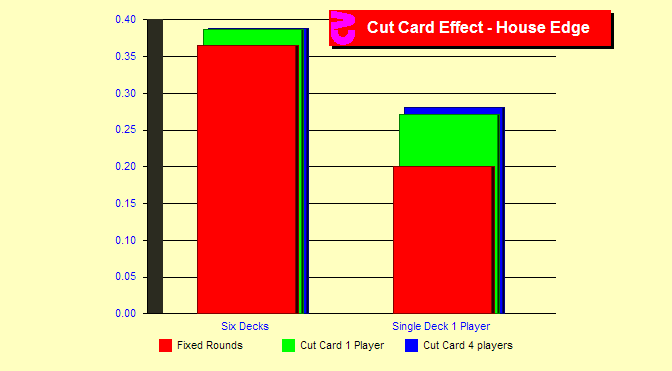
The reason that the house edge is relative to the original wager, not the average wager, is that it makes it easier for the player to estimate how much they will lose. For example if a player knows the house edge in blackjack is 0.6% he can assume that for every $10 wager original wager he makes he will lose 6 cents on the average. Most players are not going to know how much their average wager will be in games like blackjack relative to the original wager, thus any statistic based on the average wager would be difficult to apply to real life questions.
The conventional definition can be helpful for players determine how much it will cost them to play, given the information they already know. However the statistic is very biased as a measure of risk. In Caribbean stud poker, for example, the house edge is 5.22%, which is close to that of double zero roulette at 5.26%. However the ratio of average money lost to average money wagered in Caribbean stud is only 2.56%. The player only looking at the house edge may be indifferent between roulette and Caribbean stud poker, based only the house edge. If one wants to compare one game against another I believe it is better to look at the ratio of money lost to money wagered, which would show Caribbean stud poker to be a much better gamble than roulette.
Many other sources do not count ties in the house edge calculation, especially for the Don’t Pass bet in craps and the banker and player bets in baccarat. The rationale is that if a bet isn’t resolved then it should be ignored. I personally opt to include ties although I respect the other definition.
Element of Risk
For purposes of comparing one game to another I would like to propose a different measurement of risk, which I call the 'element of risk.' This measurement is defined as the average loss divided by total money bet. For bets in which the initial bet is always the final bet there would be no difference between this statistic and the house edge. Bets in which there is a difference are listed below.
Element of Risk
| Game | Bet | House Edge | Element of Risk |
|---|---|---|---|
| Blackjack | Atlantic City rules | 0.43% | 0.38% |
| Bonus 6 | No insurance | 10.42% | 5.41% |
| Bonus 6 | With insurance | 23.83% | 6.42% |
| Caribbean Stud Poker | 5.22% | 2.56% | |
| Casino War | Go to war on ties | 2.88% | 2.68% |
| Crazy 4 Poker | Standard rules | 3.42%* | 1.09% |
| Heads Up Hold 'Em | Pay Table #1 (500-50-10-8-5) | 2.36% | 0.64% |
| Double Down Stud | 2.67% | 2.13% | |
| Let it Ride | 3.51% | 2.85% | |
| Spanish 21 | Dealer hits soft 17 | 0.76% | 0.65% |
| Spanish 21 | Dealer stands on soft 17 | 0.40% | 0.30% |
| Three Card Poker | Ante & play | 3.37% | 2.01% |
| Ultimate Texas Hold 'Em | 2.19%* | 0.53% | |
| Wild Hold ’em Fold ’em | 6.86% | 3.23% |
Standard Deviation
The standard deviation is a measure of how volatile your bankroll will be playing a given game. This statistic is commonly used to calculate the probability that the end result of a session of a defined number of bets will be within certain bounds.
Single Deck Blackjack Game
The standard deviation of the final result over n bets is the product of the standard deviation for one bet (see table) and the square root of the number of initial bets made in the session. This assumes that all bets made are of equal size. The probability that the session outcome will be within one standard deviation is 68.26%. The probability that the session outcome will be within two standard deviations is 95.46%. The probability that the session outcome will be within three standard deviations is 99.74%. The following table shows the probability that a session outcome will come within various numbers of standard deviations.
I realize that this explanation may not make much sense to someone who is not well versed in the basics of statistics. If this is the case I would recommend enriching yourself with a good introductory statistics book.
Standard Deviation
| Number | Probability |
|---|---|
| 0.25 | 0.1974 |
| 0.50 | 0.3830 |
| 0.75 | 0.5468 |
| 1.00 | 0.6826 |
| 1.25 | 0.7888 |
| 1.50 | 0.8664 |
| 1.75 | 0.9198 |
| 2.00 | 0.9546 |
| 2.25 | 0.9756 |
| 2.50 | 0.9876 |
| 2.75 | 0.9940 |
| 3.00 | 0.9974 |
| 3.25 | 0.9988 |
| 3.50 | 0.9996 |
| 3.75 | 0.9998 |
Hold
Although I do not mention hold percentages on my site the term is worth defining because it comes up a lot. The hold percentage is the ratio of chips the casino keeps to the total chips sold. This is generally measured over an entire shift. For example if blackjack table x takes in $1000 in the drop box and of the $1000 in chips sold the table keeps $300 of them (players walked away with the other $700) then the game's hold is 30%. If every player loses their entire purchase of chips then the hold will be 100%. It is possible for the hold to exceed 100% if players carry to the table chips purchased at another table. A mathematician alone can not determine the hold because it depends on how long the player will sit at the table and the same money circulates back and forth. There is a lot of confusion between the house edge and hold, especially among casino personnel.
Hands per Hour, House Edge for Comp Purposes
The following table shows the average hands per hour and the house edge for comp purposes various games. The house edge figures are higher than those above, because the above figures assume optimal strategy, and those below reflect player errors and average type of bet made. This table was given to me anonymously by an executive with a major Strip casino and is used for rating players.
House Advantage Single Deck Blackjack Rules
Hands per Hour and Average House Edge
| Games | Hands/Hour | House Edge |
|---|---|---|
| Baccarat | 72 | 1.2% |
| Blackjack | 70 | 0.75% |
| Big Six | 10 | 15.53% |
| Craps | 48 | 1.58% |
| Car. Stud | 50 | 1.46% |
| Let It Ride | 52 | 2.4% |
| Mini-Baccarat | 72 | 1.2% |
| Midi-Baccarat | 72 | 1.2% |
| Pai Gow | 30 | 1.65% |
| Pai Pow Poker | 34 | 1.96% |
| Roulette | 38 | 5.26% |
| Single 0 Roulette | 35 | 2.59% |
| Casino War | 65 | 2.87% |
| Spanish 21 | 75 | 2.2% |
| Sic Bo | 45 | 8% |
| 3 Way Action | 70 | 2.2% |
Footnotes
* — House edge based on Ante bet only as opposed to all mandatory wagers (for example the Blind in Ultimate Texas Hold 'Em and the Super Bonus in Crazy 4 Poker.
Translation
Single Deck Blackjack Trainer
A Spanish translation of this page is available at www.eldropbox.com.